VI
VI


After a long, restful sleep to catch up on sleep after an early morning cloud-hunting trip in Cau Dat, I woke up to find the weather so beautiful that I immediately invited Son, a friend from the group, to come along. Without hesitation, Son said we should go early to have time to explore, enjoy the sunshine for taking pictures, and return early because the sky in the forest gets dark quite quickly.
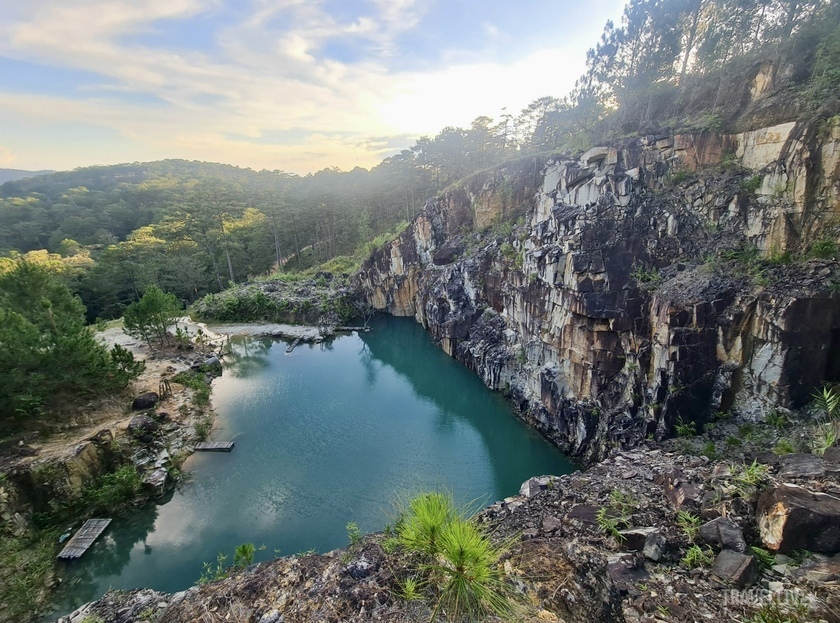
Scenery at Tuyet Tinh Coc (Valley of Love) in Da Lat
Around noon, Son rented a sturdy motorbike, neatly dressed in his hat and jacket, went for lunch, and then set off. Leaving the center of Da Lat, after turning off Xo Viet Nghe Tinh Street onto Ankroet Street, a different Da Lat unfolded—truly Da Lat. Sunshine and wind abounded, the sun shining down on the endless stretches of dark green pine forests on both sides of the road, making the pine needles shimmer with a phosphorescent, magical light. Sitting behind him, I occasionally took out my phone to photograph the pristine, sun-drenched, wind-filled stretches of road, the trees touching each other, making us feel colder than usual. This route had fewer wild sunflowers than the section from the airport to the city center, but the further we went, the more we felt like we were lost in the most beautiful forest road in Vietnam.
The car sped along the path leading to the Golden Valley, past the Ma Rung Inn, across the Ankroet spillway, past the famous solitary pine tree of Da Lat and the pink grass hill, crossing Lake Dankia and then Lake Suoi Vang. Interestingly, while Lake Dankia has a deep yellow color characteristic of the basalt soil of the Central Highlands, Lake Suoi Vang has a silvery white color. The wind whistling through the sun-drenched pine trees created a sound like an endless violin symphony of wondrous nature. We passed through Bidoup – Nui Ba National Park, the "roof of the Central Highlands" with its two peaks: Bidoup, 2,287 m high, and Nui Ba, 2,167 m high.
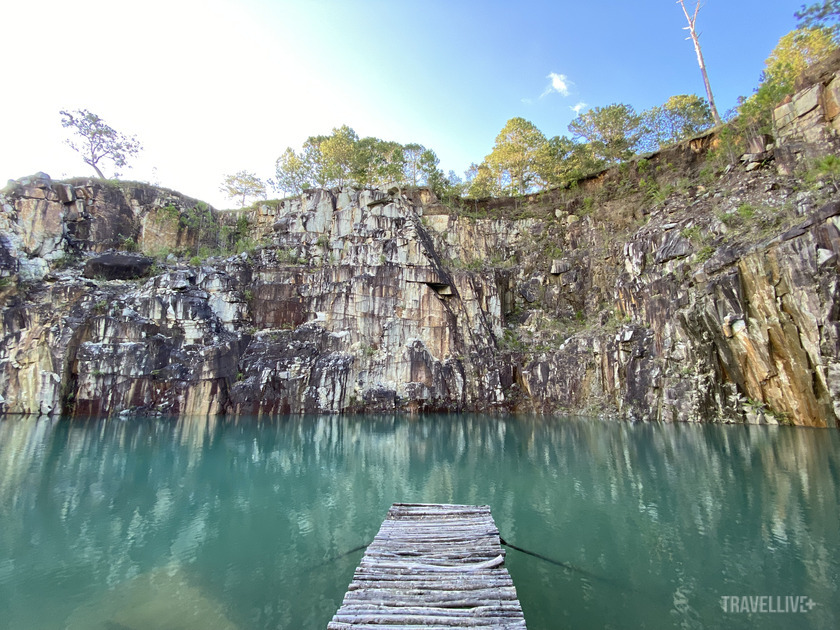
The towering cliffs look incredibly imposing, and the lake below is a clear, turquoise color, formed by the mixing of rainwater and available groundwater.
The scenery was so beautiful that we got lost for quite a distance, and only realized we were out of touch when we lost phone signal. Once we got back to the internet, we drove for a while and finally reached Cù Lần Village. This place was temporarily closed after the incident where several South Korean tourists died. We stopped to take a few pictures from the village gate and checked Google Maps again, seeing that it only showed 6.5 km further to Tuyệt Tình Cốc (Valley of Love).
It turned out that the turnoff to Tuyet Tinh Coc (Valley of Despair) was something we had passed twice before, but because it was a forest entrance, we hadn't paid attention to it, starting with a dusty dirt road. There was a muddy section, for some unknown reason, but after passing through it, we knew for sure that on a rainy day, a motorbike like that would be impossible to get through.
The further we went, the darker the forest became, and the greenhouses for growing vegetables and flowers almost disappeared. Narrow valleys stretched below the dark green hills, tangled with vines. Finally, Google Maps directed us to a small road. It's called a road because there were no trees growing on it, and its color was a silvery hue due to the presence of vehicles; it was actually a mountain path, a jumble of rocks interspersed with small mounds of earth, sometimes with deep trenches about a third the size of a car wheel, probably formed by rainwater runoff from above. Where it was flatter, the path was a winding trail of large pine roots protruding like a swarm of snakes wriggling in a swamp. It was very difficult to navigate.

But the scenery was breathtaking. The more secluded a place was, the more it possessed a wild, hidden, and captivating beauty. Sunlight streamed down the mountain slopes, illuminating the straight, sturdy pine trees and casting vibrant, wild, three-dimensional images onto the ground. Occasionally, butterflies and birdsong echoed clearly through the tranquil, ancient forest.
The engine still rumbled, like someone struggling to climb a steep slope. After a short distance, the two of us stopped at a patch of pine forest, gulped down a full bottle of water, stood catching our breath, and then slowly got back on the bike and continued. We reached the exact spot indicated by Google Maps: "You have arrived," but still saw nothing. Son looked around and pointed to the path on the left, where several ribbons were tied, saying, "Let's go in there and see." We went in, but it was still downhill, and we figured it wasn't the right place. In our minds, the Valley of Despair should be a place with murmuring streams and waterfalls. But even in the quiet afternoon forest, all we could hear was the faint sound of birds.
The two brothers, bewildered and helpless, quickly grabbed their phones and started calling relatives. After making the call, Son looked thoughtful and said, "My friend told me the entrance to Tuyet Tinh Coc is near a wooden house. Now we need to go find that wooden house to pinpoint its location."
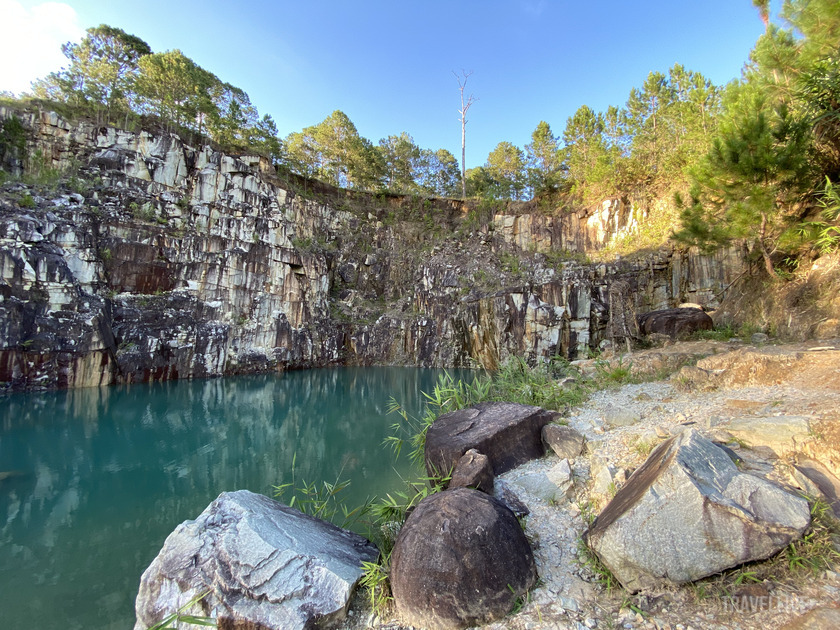
Tuyet Tinh Coc (Valley of Heartbreak) is likened to a picturesque landscape amidst the highlands.
As I was walking, I suddenly saw a pickup truck speeding out of the forest like a fairy godmother. I quickly jumped out and asked for directions. The driver said to continue for about 50-60 meters, and the path above would lead us there. The road wound around a low hill, still rough and bumpy, so I got out and continued walking, letting Son drive ahead alone. While I was panting, my shirt soaked with sweat, and staggering along, I suddenly heard Son shout: "We're here, brother! It's so beautiful!" Son's voice echoed against the cliffs and the forest in the strange afternoon sun, repeating itself in a surreal, ethereal way.
A crystal-clear, emerald-green lake nestled in the heart of an ancient forest, surrounded by towering limestone cliffs. The layers of rocks, weathered by time, cast their reflections upon the water's surface. The color of the water reminded me of the vibrant blue of the sacred Yangtuo Yongzhuo Lake in Tibet. The afternoon sun, the clouds, the ancient forest, the cliffs, and the lake created a breathtaking scene with a surreal beauty, reminiscent of scenes from ancient films. Standing there, gazing at this magnificent sight, I suddenly thought: Yang Guo and Xiaolongnu living in this setting, surrounded by wind and clouds, deeply in love with their soulmate, far removed from the mundane world—there could be no greater paradise of happiness than this.
Looking at the makeshift bridges made from tree trunks stretching out over the lake, or the swings constructed from dry branches above, along with the information my friend told us about the jeep tours, we understood that this place used to be an adventure tourism destination. But now, these bridges and swings have become "heritage" in an almost completely desolate area.
We were taking pictures and marveling at the beautiful scenery. It started with the bridge on the left of the entrance, extending to a large rock where a solitary tree stood in the middle of the lake, then progressing to the bridge in the middle of the lake, and finally to the precarious rock on the right, bathed in the enchanting afternoon sunlight, as if Mother Nature had draped an unfinished golden thread across the landscape.
Opposite the tree growing in the middle of the lake, looking up, was a large, thick rock with a fairly smooth surface. Looking at it, I thought how wonderful it would be if some supreme martial arts master could write the three Chinese characters "Tuyệt Tình Cốc" (Valley of Despair) on it with their finger. After wandering around and admiring it for a long time, my brother and I still weren't satisfied and didn't want to leave, so Sơn suggested I climb up to look down and see what it was like, maybe we'd discover something unexpected.
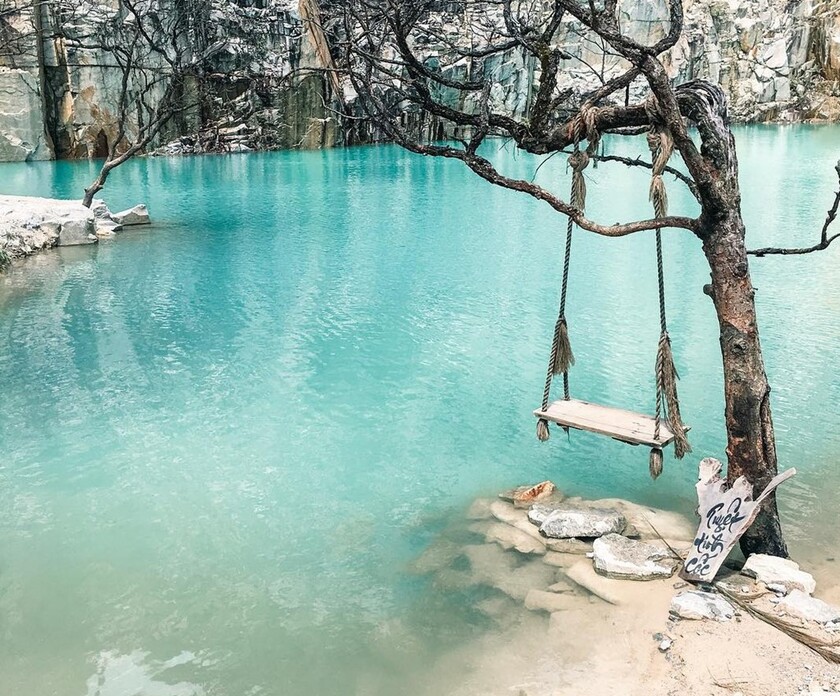
Beautiful nature
From above, the Valley of Despair looked even more surreal with its towering limestone cliffs and trees precariously perched above, making me imagine they could crash down at any moment if a heavy rainstorm hit. The upper half was bathed in sunlight, dividing the landscape into two halves: one bright and the other shrouded in mist. The lower half, veiled in the haze of the lake and forest in the evening, divided the landscape into two halves of muted tones. We stood there, gazing intently at the scenery, trying to take it all in, trying to capture every detail with our eyes.
By the time the two brothers climbed down, it was late afternoon, with only a faint glimmer of sunlight. They had already wandered around here for over an hour, but they had to go back if they didn't want to cross the dense forest in the pitch-black darkness.
The journey back was rough and bumpy, but everyone felt satisfied. Everywhere in our country is beautiful, but there are some uniquely surreal, strange, and magnificent landscapes reserved only for those who deeply love nature, who dare to travel and explore, to experience moments of exhilaration and joy amidst the vast expanse of the open sky.