VI
VI


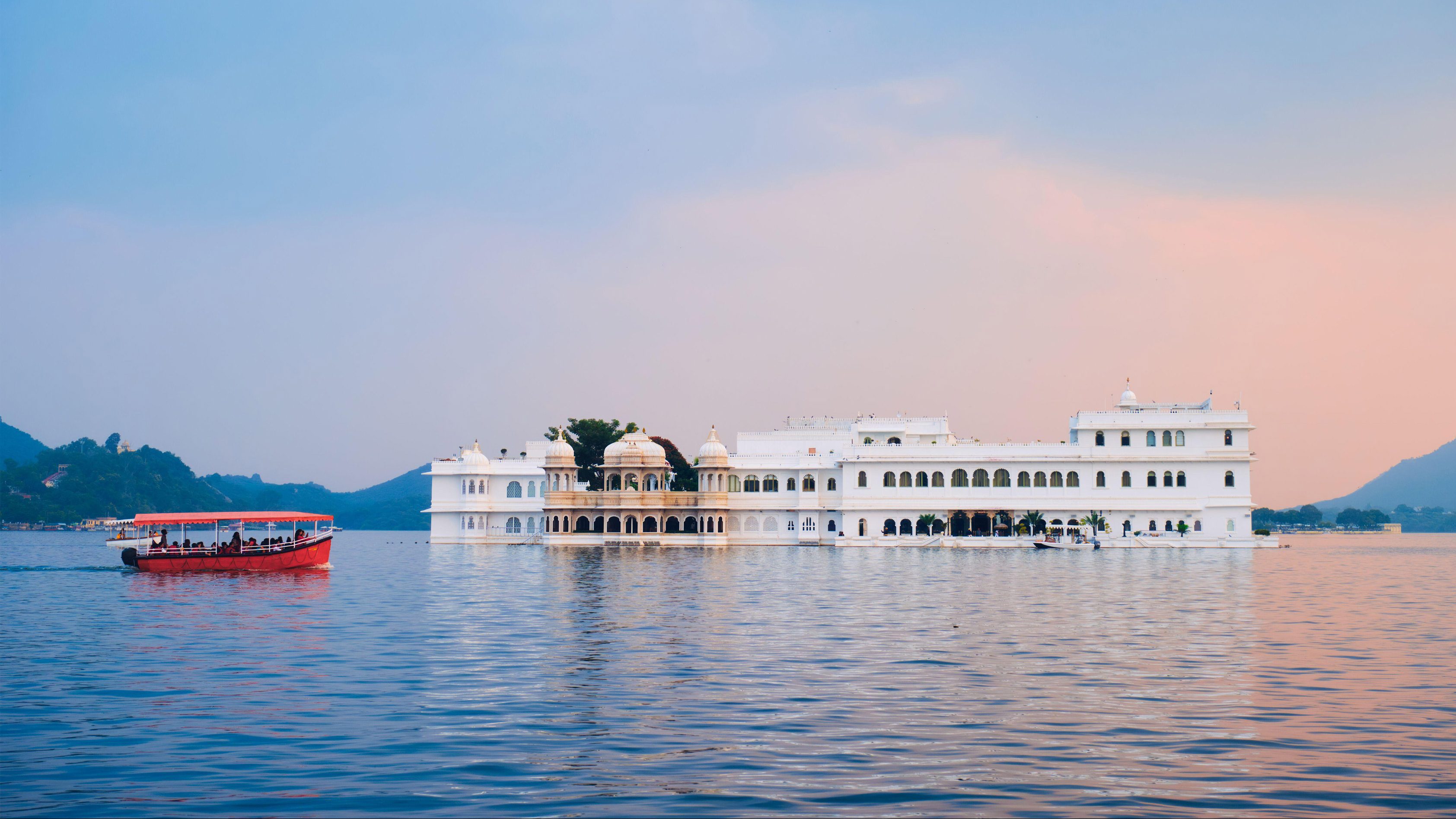
My friends often jokingly ask how I was so lucky to have a long internship in Udaipur – a city in the heart of India that's as beautiful as Europe. I think it's partly due to fate. I never imagined the breathtaking beauty of Udaipur before I set foot there. Later, after reading more, hearing more stories about its culture and history, traveling through different cities in India, and then returning to this city a second time, I was able to appreciate more of Udaipur's hidden beauty.
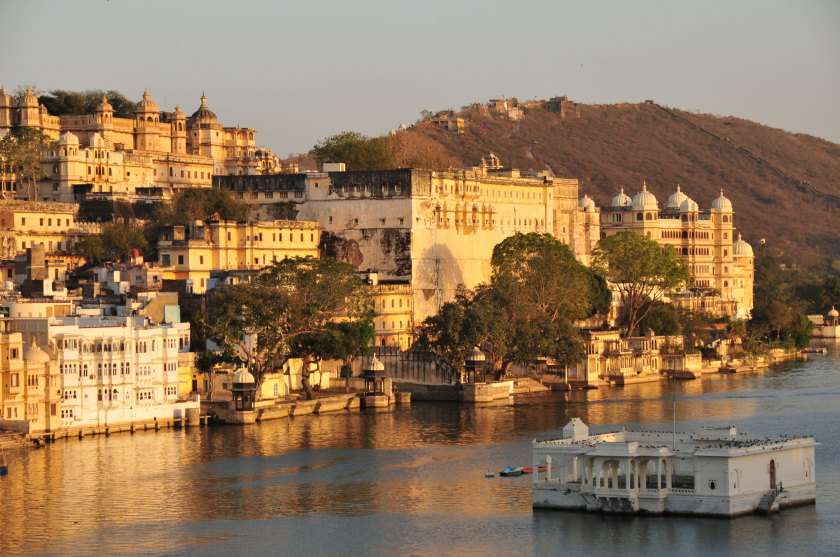
Udaipur city is known as the "Venice of the East".
Udaipur – the Venice of the East
I think the main reason is that I stayed in this city longer than in other places, so my feelings for this land are deeper. Or, deep down, it's because I've always liked tranquility, so I was easily captivated by the romantic and refined atmosphere that Udaipur offers. For me, Udaipur has much more to offer than just its glamorous and attractive appearance, as the media calls it, "the Europe of India" or "the Venice of the East."
With the soul of someone who loves experiences, I think I was also captivated by the simplicity of the people, the serenity of nature, and the solemnity of the religion here. Another special thing that always comes to mind is the necessary contrast of Udaipur within India. This city still possesses its own unique beauty, poetic and romantic, but has never lost the distinctive characteristics found only in a country as exotic as India. I think to mention or describe a city, one can use its name as an adjective. This expresses its unique characteristics, which cannot be confused with any other place.
Just as we look at a picture and immediately recognize it as very Hanoi or very Saigon. To be able to use such an adjective, I think I need time for my soul to truly be exposed, for the rhythm of life in a new land to cleanse me, to immerse myself in experiences and lessons from different hidden corners of the city. For me, after traveling to many different cities and states in India, I can confidently say that Udaipur can absolutely be considered an adjective. Udaipur is a beautiful, gentle, and charming city located in Rajasthan – in northeastern India. Rajasthan is known for its hot weather due to its vast deserts. Udaipur is no exception; a large part of its area lies in desert, resulting in a hot and humid climate.
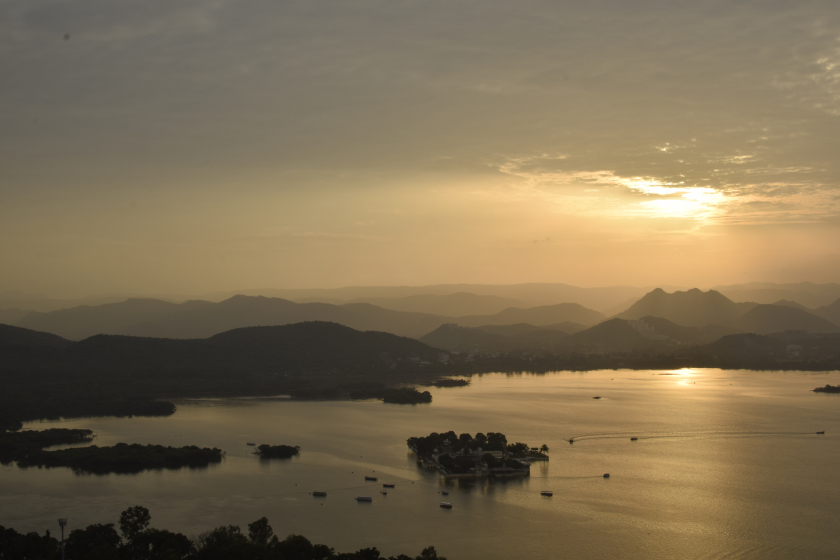
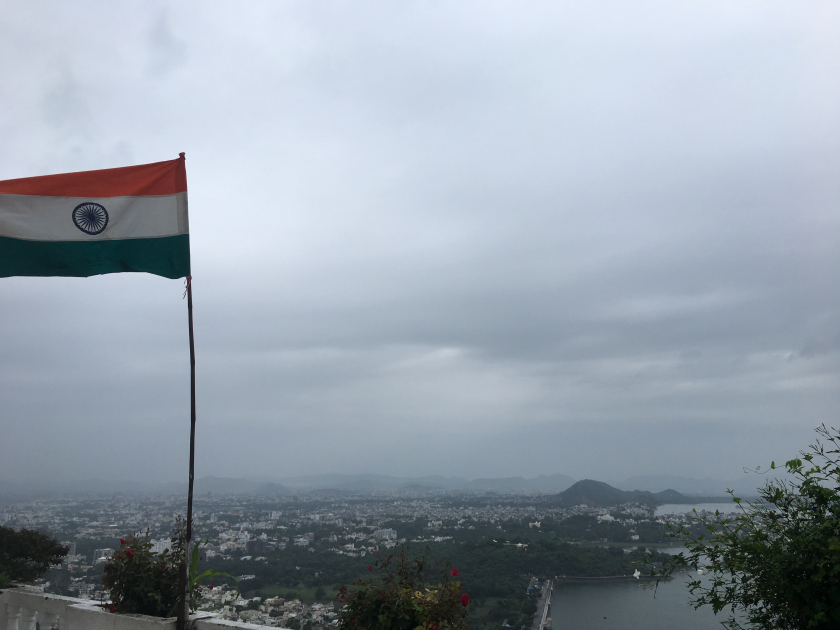
One evening, I gazed at the city of Udaipur from above, overlooking the river at sunset.
However, thanks to its natural beauty, surrounded by numerous lakes and high mountains, the climate here is generally not too harsh. The complex network of lakes has led people to always think of Udaipur as the city of lakes. Every weekend, or on holidays, when I go out with friends, I get to visit new mountains or admire different lakes from the towering temples of Udaipur such as Fateh Sagar or Pichola...
I've often wondered about the tranquility of Udaipur, situated in a barren desert like Rajasthan, where, just hundreds of years ago, people fought for survival. But now, gazing upon this peaceful Udaipur, there's no more fitting answer than to believe it truly is a gift from nature.
Legend has it that this land is arid and harsh because, long ago, a sage passed through. After meditating, he sought water to drink and asked the people around him for it. But they all refused and treated him rudely. So he cursed the land. Because this place had once refused him water, it would never have enough to drink and would face great difficulty in finding it. And since then, the whole of Rajasthan has become arid and desert, paying the price for his rudeness.
A tranquil haven amidst the hustle and bustle of India.
Udaipur is also considered the city of palaces. The old city still retains traces of its golden age when Udaipur was the capital of the Mewar kingdom. Most of the palaces and castles in Udaipur, as well as other old architectural structures in the city, are influenced by the architecture of the Rajput warrior class in Northwest India, thus preserving their luxurious and opulent appearance.
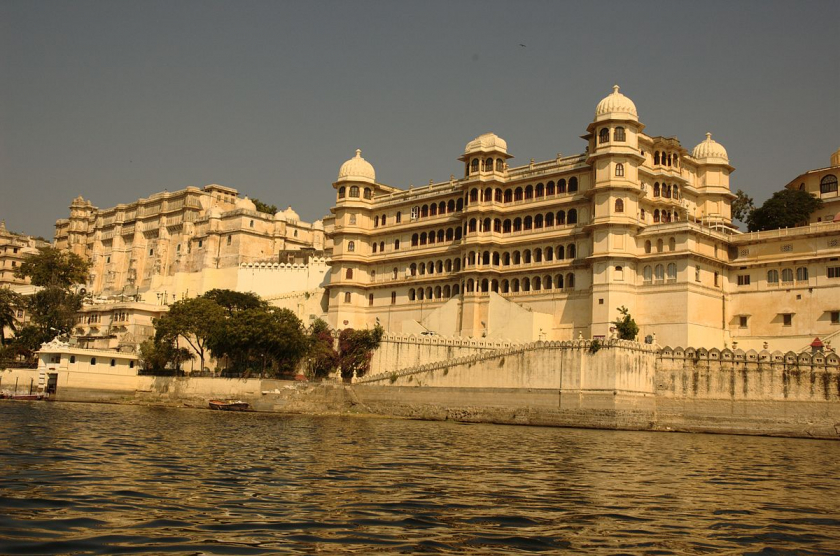
Udaipur is a city of ancient palaces.
In ancient times, the entire Rajasthan region was under the control of Rajput warriors. The old name for Rajasthan was Rajputana, meaning "land of the Rajputs." The Rajput warrior class, along with the Brahmin priestly group and the remaining royal families, held significant wealth and property in Udaipur, a legacy that continues to this day. Furthermore, it is home to numerous historical forts, museums, galleries, temples, and traditional festivals and fairs. Along the outskirts of Udaipur stand the imposing forts, remnants of the Mewar kingdom and the Rajput warriors. Upon returning home, my deepest regret is that during my two months in Udaipur, I didn't spend more time exploring the rich culture, people, and history of this region.
One of my favorite spots in Udaipur is the shore of Lake Pichola, also known as Gangor Ghat (Ghat means shore). From the shore, looking across the river, you can see hotels and ancient palaces, remnants of a Rajasthani land once ruled by many famous kings. Additionally, the lake shore is a favorite spot for Udaipur residents on dry days. At those times, the water near the shore recedes, leaving steps where people can sit, chat, and admire the picturesque scenery.

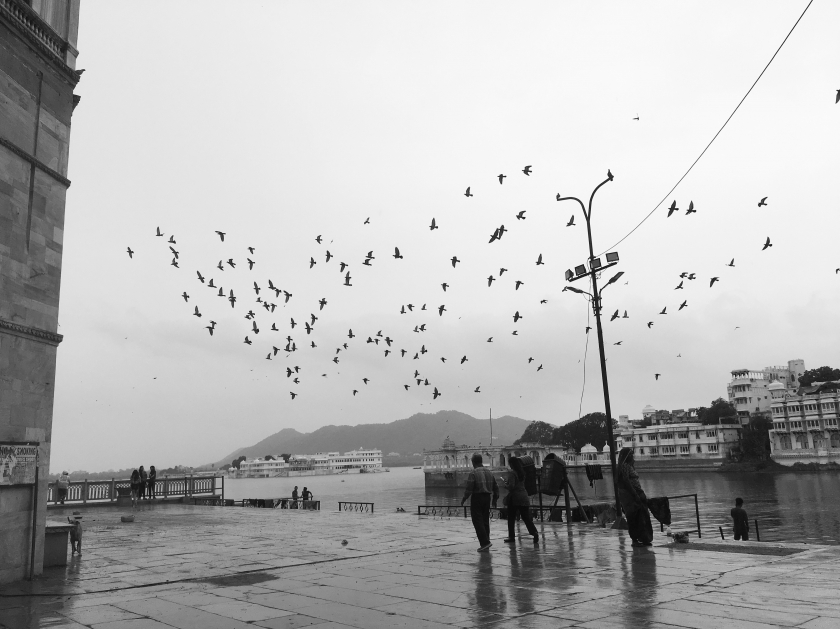
Locals and tourists stroll along the shores of Lake Pichola.
My guide and I once spent an entire afternoon chatting there, reminiscent of the steps of knowledge depicted in Renaissance paintings of Athens. On another occasion, traveling alone, I stood silently watching the birds fly across the lake, amazed that the scene was so similar to the European scenes I had seen in films.
A land of ancient spirituality and beliefs.
The Jagdish Temple behind the riverbank also piqued my curiosity. This ancient Hindu temple, the largest and most famous in Udaipur, is dedicated to the god Vishnu and was built by Maharana King Jagat Singh I in the 17th century. If you happen to be walking along the streets or see friends with the surname Singh, they might be descendants of the king. The temple has three levels and distinctive towers. It's a typical example of Indo-Aryan architecture, with every column, wall, and ceiling filled with intricate carvings of elephants, horses, dancers, musicians, musical instruments, etc., each animal representing a different deity.
Every time I go to the temple, I usually choose to sit in a corner and watch people perform their rituals and ceremonies. I try not to do anything, just to observe everything, to let everything take in without reacting. I never imagined that it would later become a habit of mine every Saturday.
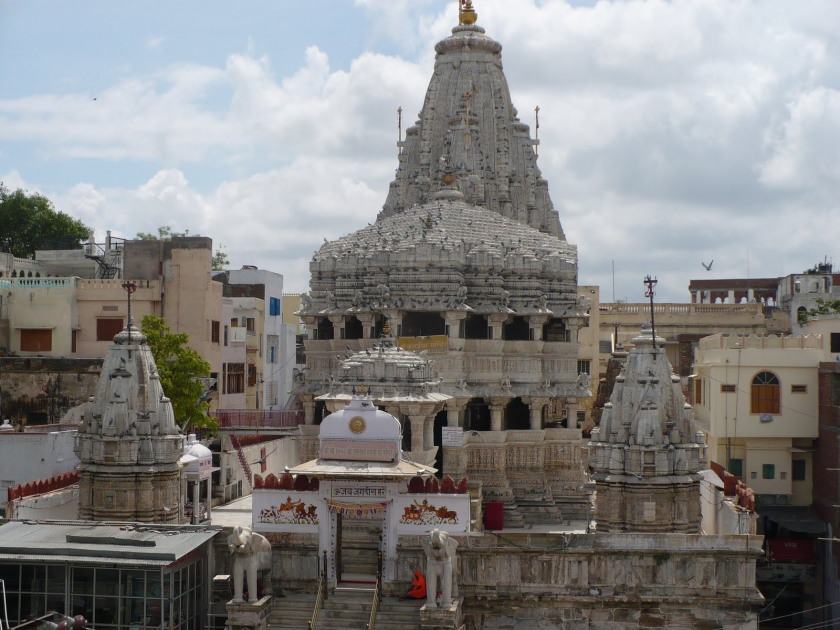
The Jagdish Temple complex is an ancient and sacred site in Indian culture.
After finishing work, I walked from my workplace to Fatehpura Circle, waited for a tuk-tuk to pass by, told the driver my destination was the central market, paid exactly 10 rupees, smiled brightly at the people in the tuk-tuk (because I knew they were curious about me), and leisurely gazed at the city. At the tuk-tuk station, I walked along the bustling little slopes, then climbed the steps to the temple, sitting there from afternoon until late evening. I heard unfamiliar sounds – people, objects, singing, and perhaps even the voices of deities somewhere. I accepted whatever food people offered, like a piece of freshly offered cake, some dried coconut, or a bruised guava.
I sat there, watching the stream of people passing by, observing both the chaos of the bustling crowd and the peace of mind at the same time. Sometimes I lost track of time because I had turned off my phone before entering the temple. Once, I stayed until late at night, and my friends had to frantically search for me, only breathing a sigh of relief when they found me safely seated in a corner of the temple. Hindu temples are easy to find on the streets of Udaipur; there are also temples of the Jain religion, another religion in India.
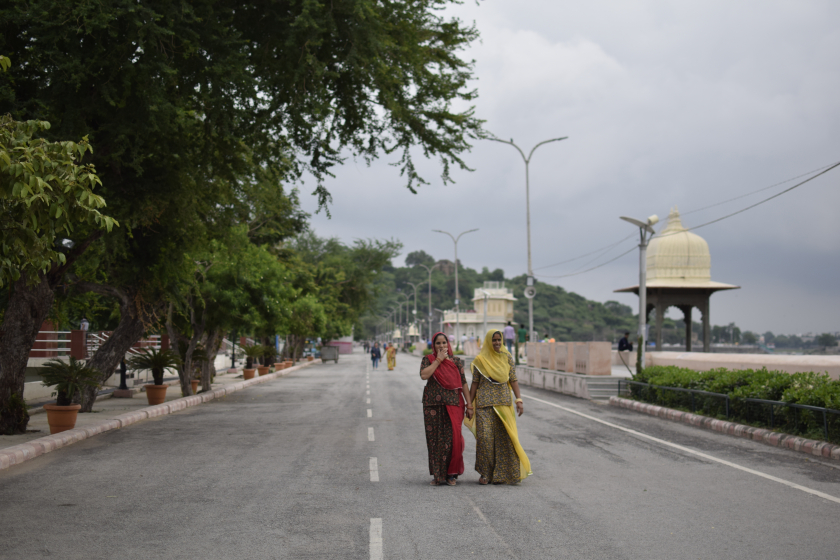
People in Udaipur take a stroll by Fateh Sagar Lake.
That's when I'm alone, but when I go out with friends, I'm usually invited to Fateh Sagar Lake, a more bustling and crowded place. I go there in the morning to see the palace, river, and mountains in tranquility, or perhaps in the evening to experience the lively atmosphere as many people stroll around and eat. Fateh Sagar is surrounded by hills and patches of forest, and it's also connected to Pichola Lake by a small canal. It's a familiar spot for my group of friends in Udaipur for birthdays, gatherings, or debates.
Besides admiring the lake, on many weekends I also enjoy hiking with friends in Udaipur. The mountains in Udaipur aren't too difficult for me; they're not as steep or demanding as the mountains I've climbed in Vietnam. Usually, these weekend hikes are simply an opportunity to meet friends and connect with nature, rather than an adventurous experience.
A popular spot for mountain climbing is the summit of Lake Badi, another artificial lake built to alleviate the severe effects of drought in Rajasthan. Particularly during the record-breaking drought of 1973, Lake Badi was a lifesaver for thousands of people in Udaipur. Beyond Udaipur, Lake Badi is renowned throughout India for its crystal-clear, emerald-green waters.
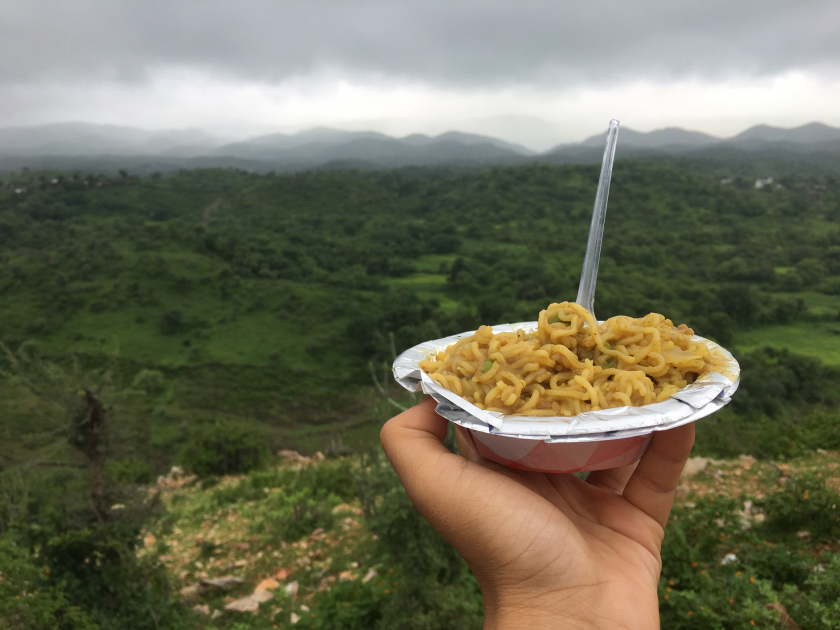
Enjoy afternoon tea on top of Lake Baldi.
In Udaipur, there's another contrast: the contrast between tradition and modernity. Most of the temples, lakeside areas, and palaces are located in the old city, while the developed parts are in the eastern part of the city. I rarely venture to the other side of the city, where IT parks, shopping malls, hospitals, and schools are being built every day. Most tourists tend to visit the old city, famous for its markets selling marble, renowned jewelry, and scenic attractions.
Interestingly, Udaipur is also known as the "paradise of cows." Researchers in Udaipur have found that cows, and other animals, are a symbol of wealth and abundance in this city. The fact that humans and animals live together even on the streets and in residential areas, sharing the use of public spaces like streets, parks, squares, and intersections, is truly unique in India and hard to find anywhere else in the world. The story of cows is long, and we'll address it in another epic chapter.
Udaipur has always maintained its elegant charm precisely because of its cozy and inviting atmosphere.
My days wandering around here made me realize that what makes Udaipur so elegant is its cozy, understated charm. It's not a massive or densely populated city like some others in India. The slow pace of life became familiar during my time in India, and it required a great deal of adaptation. At first, I found it a little uncomfortable, but having no other choice, I learned to find joy in the waiting. So, with a leisurely and unhurried pace, the rhythm of Udaipur blended into my previous hectic life, allowing us to enjoy our time together at a relaxed pace.
The poet Chế Lan Viên once wrote in his poem "The Song of the Ship":
"Remember the misty village, remember the cloud-covered mountain pass."
Wherever I go, my heart is filled with love.
When we live there, it's just a place to live.
"As we leave, the land has become a part of our soul!"
Ultimately, "Wherever you go, your heart will always fall in love?" Few people realize that the land they only settle in for a short time becomes a significant part of changing them, allowing their souls to explore different and wondrous horizons. Indeed, living in a city, letting the things inherently tied to it cleanse my being, is always a fascinating experience I long to have during my years of wandering.
Additional information:
By plane: Travelers can fly directly to Delhi or Mumbai airport and then fly to Udaipur airport.
Boat travel experience: Visitors to Delhi or Mumbai can also book train tickets online through the IRCTC online booking website. Additionally, travel portals such as Cleartrip.com, Makemytrip.com, and Yatra.com now offer online train ticket booking services.
Visa: For tourists, the most common visa is the Double Entry e-Tourist visa. This visa allows entry into India no more than twice. The maximum stay per entry is 60 days, with processing time not exceeding 3 days.