VI
VI


Airfares in Asia in February were 33% higher than the same period in 2019, and 12% and 17% higher than in Europe and North America, respectively, according to data from Skyscanner Travel Insight, the world's leading flight search app.
Economy class airfares to Asia from North America and Europe are projected to increase by 9.5% and 9.8% respectively this year, according to forecasts from the travel app American Express Global Business Travel (Amex GBT). Business class fares are expected to follow a similar trend. "On some routes, passengers are paying double what they paid four years ago," CNN noted.
According to Amex GBT, business class tickets for the Paris-Shanghai route cost $5,650 in 2019 and are now $11,500. The same applies to the Singapore-Shanghai route. The app also predicts even higher prices for intercontinental flights (from Asia to other continents), as airlines' flight frequencies remain lower than before the pandemic.
Specifically, economy class airfares from Asia to Australia increased by 5.1%, to Europe by 14.5%, and to North America by 10.3%. Conversely, fares increased by 24.9%, 9.8%, and 9.5% respectively.
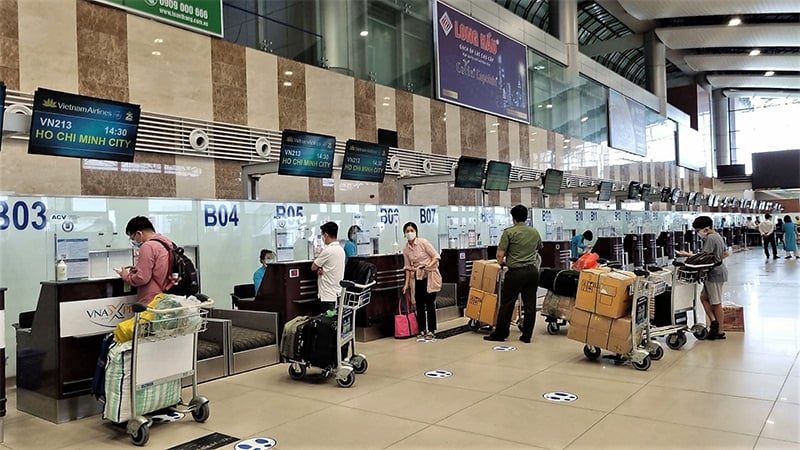
Customers check in at Noi Bai Airport.
Customers from the Asia-Pacific region are facing higher airfares than those from other regions. This indicates an uneven recovery after the pandemic. Experts say this issue is not expected to end anytime soon. Hugh Aitken, a representative from Skyscanner, notes that global airfares are higher than before Covid-19 due to "a multitude of factors." High costs, staffing shortages, and Russia's airspace closure are among the reasons for the price increase.
But the main limitation is that Asia is still in the early stages of reopening. North America and Europe eased border restrictions early last year. Major destinations in Asia, such as China and Japan, have only recently reopened. According to Aitken, the places that lifted pandemic restrictions the latest also had the slowest resumption of flights, leading to higher ticket prices. "Right now, that's APAC (Asia-Pacific)," Aitken said.

When people are allowed to travel, demand increases, and airlines cannot easily add services immediately. Jeremy Quek, a representative of Amex GBT, said the airline needs at least a month to plan and then put it into practice.
The CEO of Trip.com, one of China's largest booking and ticketing apps, said that although China has reopened, flight capacity is currently only at 15-20% of pre-pandemic levels. Meanwhile, the capacity of long-haul international flights, such as those between Europe and Asia, in the first quarter was only 17% of 2019 levels.
"Airline capacity is recovering, but not at the pace we expected. That's the key issue. Decreased capacity and increased demand are the recipe for price increases," Quek said.
In 2022, Russia imposed an air blockade as tensions with Ukraine escalated. Many flights had to be rerouted, making journeys longer and more expensive. Currently, restrictions remain in place. The routes most severely affected are Asia-North America or Europe.
"The Tokyo-London route now has to go east across the North Pacific, Alaska, Canada and Greenland, adding 2.4 hours of flight time and burning approximately 5,600 gallons of fuel, increasing costs by 20%," Amex GBT said in a report.
In addition, fuel costs have also skyrocketed. Alan Joyce, CEO of Australian airline Qantas, said the company's fuel bill is 65% higher than in 2019. "Airfares will have to be higher because fuel is more expensive," Joyce said. Joyce also said the airline needs time to retrain its flight crews who were laid off during the pandemic.
"Our pilots have been driving buses in Sydney and Melbourne for a while because they have no work," Joyce said. Therefore, getting a pilot back to flying requires additional training costs for the airline.
Despite high ticket prices, experts believe this will not deter travelers. They have not seen any signs of a slowdown in tourist demand. Aitken stated, "We are seeing strong and continued customer demand on the Skyscanner platform for travel in 2023."
Some airlines are still offering discounted fares. Qantas and Jetstar have announced a reduction of over one million seats this year on both domestic and international routes. Japan Airlines has also attempted to lower prices. The airline's website crashed in early March after launching a promotion that caused a surge in traffic.
"In the current situation, the easiest way to find good deals is to book early," Aitken said.