VI
VI




In an announcement on March 30, the Korea Customs Service (KCS) stated that the plan was initially scheduled to be implemented in July, but because the policy aligns with the government's strategic direction to boost domestic consumption, authorities decided to move it forward.
The aim of streamlining procedures is to increase the number of international tourists visiting South Korea, with the goal of welcoming 10 million visitors this year, and to boost domestic consumption, which has been weakened by persistently high inflation.
By easing restrictions on international tourists, the South Korean government aims to attract more foreign visitors and increase spending to stimulate the economy without raising prices.

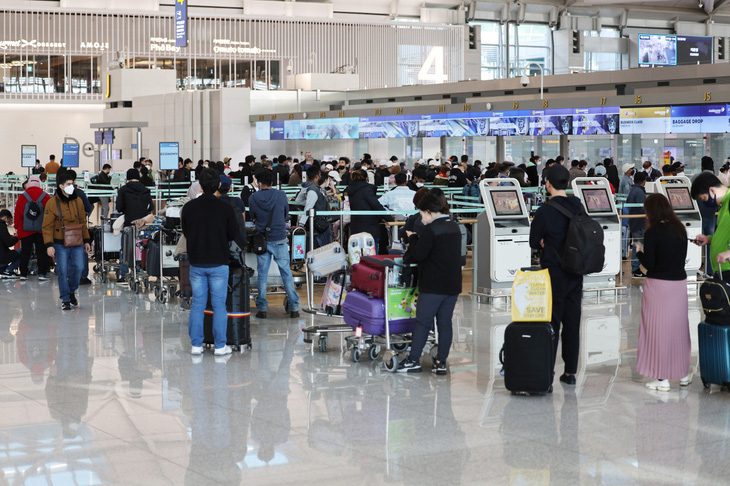
Passengers line up at the check-in counter at Incheon International Airport, South Korea. (Photo: yna.co.kr)
KCS stated that the decision was based on statistics showing that 98.8% of the 43.56 million international visitors to South Korea in 2019 reported having no taxable goods to declare. Specifically, 99.93% of foreign nationals stated they had no goods requiring tax declaration.
KCS stated that many countries have previously implemented measures to streamline customs declaration procedures. The United States and many European Union (EU) countries have also required international travelers to fill out customs forms only if they possess taxable goods. Taxable goods are items valued at over $800, more than two bottles of wine, or more than 60 ml of perfume.
Starting in the latter half of this year, South Korea will expand its mobile customs clearance system to Terminal 1 of Incheon International Airport, Gimhae International Airport, Daegu International Airport, Muan International Airport, Cheongju International Airport, and Jeju International Airport. Currently, this service is only available at Terminal 2 of Incheon International Airport and Gimpo International Airport.