VI
VI


A market that only appears during the month of Ramadan.
Tucked away in alley 157 on Duong Ba Trac Street (District 8), the Ramadan market is a unique culinary and cultural hub for the Muslim community in Ho Chi Minh City. Unlike traditional markets that operate year-round, this market only appears during Ramadan – the most important holy month for Muslims.
Ramadan is the ninth month of the Islamic calendar, associated with the tradition of fasting from dawn to dusk. During this time, believers abstain from food and drink during the day to focus on spiritual purification, altruism, and gratitude. At sunset, they share a meal called iftar – the meal that breaks the fast after a day of abstinence.

In 2026, Ramadan will take place from approximately February 18th to March 19th.


It was precisely the need to prepare for the iftar meal that led to the formation of the small market in Duong Ba Trac alley many years ago. Initially, it was just a place where Cham Muslim families in the area gathered to sell food to serve the community. Gradually, the market became a familiar spot every Ramadan, not only for Muslims but also for many Saigon residents who want to explore Halal cuisine.
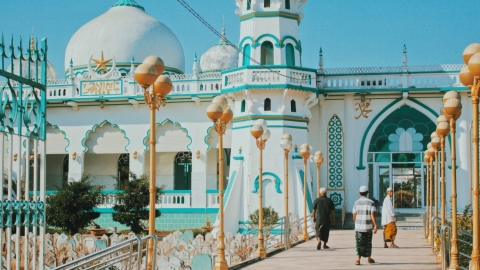
For many Muslims in Ho Chi Minh City, the market is not just a place to buy and sell food, but also a space for meeting, chatting, exchanging ideas, and sharing the sacred atmosphere of the holy month. The existence of the market therefore carries profound cultural and spiritual significance, contributing to the preservation of the Muslim community's identity in the heart of the bustling city.

Ramadan helps preserve the identity of the Muslim community in the heart of the city.
Curry aromas, grilled meats, and signature Halal dishes.
If you venture into the alley during Ramadan, the first thing you'll notice is the aroma that permeates the air. The rich, savory smell of curry, the smoky aroma of grilled meat, and the faint scent of pastries bring the entire alley to life.
The stalls are set up quite simply: a small table, a few trays of food, and a tarp over them. But behind that simplicity lies a treasure trove of Islamic cuisine.


Many dishes familiar to the Cham community can be found here, such as beef curry, chicken curry, and goat curry, often cooked with coconut milk and rich spices, and served with bread or rice. Alongside these is tung lò mò – a type of beef sausage characteristic of the Cham people, grilled over charcoal to perfection.

The iftar is incomplete without various cakes and snacks such as palm sugar rice cakes, jackfruit seed cakes, Malaysian cakes, along with many fried and grilled dishes prepared on the spot. Some stalls also sell milk tea, herbal drinks, or soft drinks to accompany the iftar meal.


The market wouldn't be complete without pastries, fried foods, and soft drinks to serve at the iftar meal.
What's special is that all the dishes here adhere to Halal standards – meaning they comply with the religious regulations of Islam. The ingredients, preparation methods, and preservation must all adhere to the strict rules of Islam.
However, prices at the market are quite reasonable. Many items range from only 10,000 to 30,000 VND, suitable for both locals and first-time visitors. This simplicity and approachability make the market very friendly to everyone.


The atmosphere, the way things are done, and the prices at the market give off a casual, down-to-earth feeling.
The small alley suddenly transformed into a food festival.
From around 3-4 pm onwards, the number of people coming to buy food increases, and Duong Ba Trac alley almost transforms into a "miniature food festival". Vendors are busy preparing dishes, smoke rises from the stoves, and customers jostle to choose from the tempting food.
The atmosphere here is both lively and yet retains the friendly feel of a small market. Most of the vendors are families living in the area, who have known each other for many years. They chat with customers while selling their goods, creating a rare sense of closeness in the bustling city.

Most of the vendors are families who have lived in the market for many years.

Among them were many Muslims, who maintained their religious attire and head coverings.
Interestingly, the market now serves not only the Muslim community. Many diners from other districts also come to experience Halal cuisine. Many people trying Islamic-style curry or Cham beef sausage for the first time are delighted with the unique flavors.
For foreign tourists, especially those interested in Islamic culture, the market becomes even more attractive. They can enjoy Halal food while observing the daily life of the Cham Muslim community in Vietnam.


Small things to keep in mind when visiting a Ramadan market.
Despite its growing popularity, the Ramadan market retains the characteristics of a small market nestled in a residential alley. The alley is quite narrow, making it inconvenient to navigate deep inside by motorbike. Visitors should park their vehicles at nearby houses for around 5,000 VND per motorbike and then walk into the market.

Visitors are advised not to drive into the alleyway as it may cause traffic congestion.
The market is usually busiest from mid-afternoon to evening, especially on weekends. If you want to experience the lively atmosphere, be prepared for the alleyways to be quite crowded, the streets narrow, and the noise to be chaotic. Ramadan usually falls at the end of the dry season in Ho Chi Minh City, when daytime temperatures can be quite high, making the space even more stuffy and humid. Visitors should prepare themselves mentally and bring appropriate personal items.

The market usually gets crowded from late afternoon onwards, especially on weekends.
Since the market takes place during Ramadan – a significant Muslim holiday – visitors should show respect for the local culture and customs. Dressing appropriately, behaving politely, and maintaining cleanliness are all important considerations.

Visitors maintain a respectful attitude towards the religion and beliefs of the Muslim worshippers at the market.
Appearing for only about a month each year, the Ramadan market in District 8 is like a "mini-festival" in the heart of Saigon. For the Muslim community, it's a place for bonding and sharing during the holy month. For many locals and tourists, the market is an opportunity to discover another interesting cultural aspect of the city – where differences are embraced with curiosity, openness, and culinary delights.