VI
VI


Hanoi's proposal to demolish the "Shark's Jaw" building, a centrally located structure on Dinh Tien Hoang Street in Hoan Kiem District, has become a topic of widespread interest among residents and tourists. Situated in a prime location on what is known as Hanoi's "golden street," this building has become a familiar symbol, associated with the memories of many generations of Hanoi residents.
The building was constructed between 1991 and 1993, with its front facing Dong Kinh - Nghia Thuc Square, its left side facing Hoan Kiem Lake, and its right side bordering Cau Go Street. Currently, the building is managed and operated by the Hanoi Transport Corporation (Transerco). Transerco is a state-owned enterprise under the Hanoi People's Committee.
Looking back in time and counting the changes on this street corner reveals the timeless love and dedication that the people of this thousand-year-old land have devoted to the capital city. Before the "Shark's Jaw" building, this place was just a small floor used as a tram control station. Its modest size in the heart of Hanoi is due, as one cultural researcher once explained, to the desire to connect the Old Quarter with Hoan Kiem Lake.
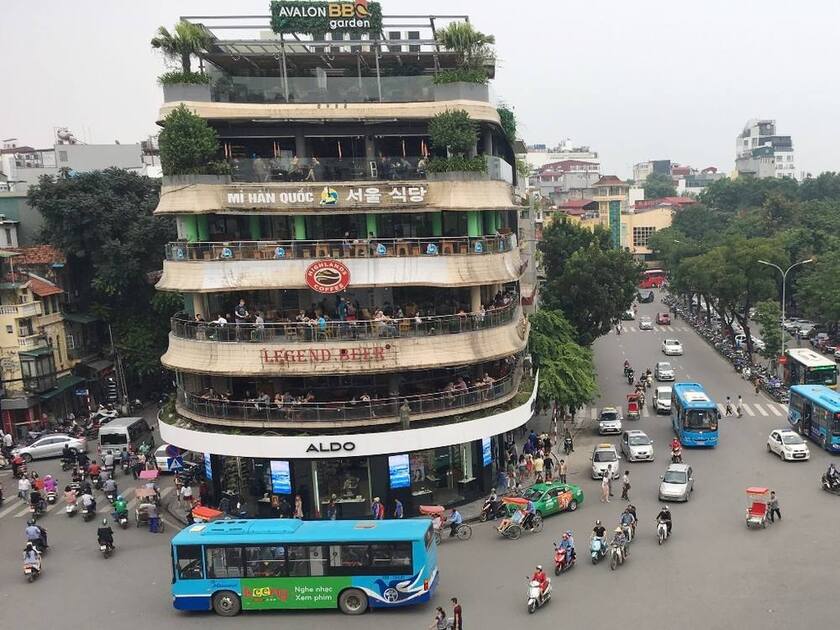
Following news that Hanoi intends to demolish the "Shark's Jaw" building (on Dinh Tien Hoang Street, Hoan Kiem District), many people are curious about this structure located in the heart of Hanoi's "golden street".
According to leaders of the Hanoi Transport Corporation (Transerco), a significant part of Hanoi's urban history is marked at the current location of the "Shark's Mouth" building. Before the 1990s, this area served as a public tram station, meeting the transportation needs of the capital's residents. When Dinh Tien Hoang Street was named, this station, located at the beginning of the street and numbered from 1 to 5, became an important transfer point for tram lines radiating to surrounding areas. Notably, the longest tram line, connecting Hoan Kiem Lake with Ha Dong (over 10 km), originated from here.
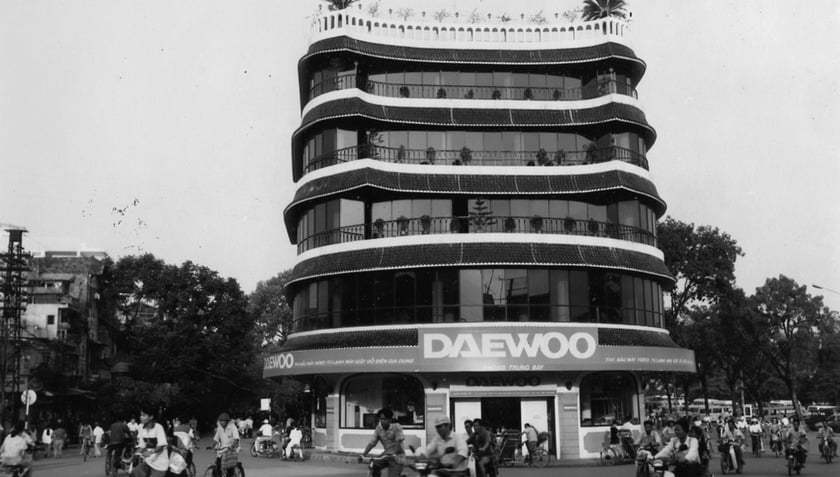
Initially, the building was named DAEWOO. On its walls, the building featured turtles (or toads) crawling upwards towards the sky, but these were later removed.
After 1990, as trams were gradually replaced by more modern modes of transport, the Hoan Kiem Lake tram station at Dong Kinh Nghia Thuc Square was allowed by the city to change its function from serving public transport to commercial business. Seizing this opportunity, Hanoi Tram Company, one of the four predecessors of Transerco, collaborated with consultants and architects to design a new building on the old site.
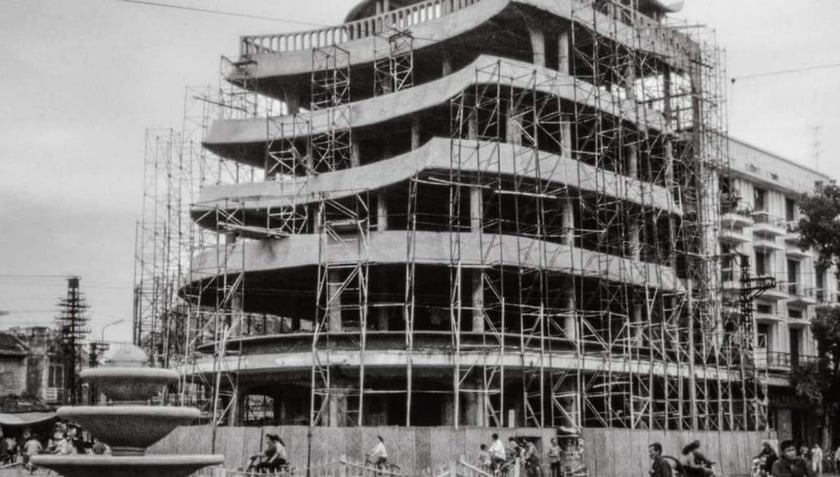
The building holds within it the memories of the people of the capital city.
After numerous discussions and consultations with city leaders, the idea for a five-story building with a unique architectural design, resembling a "Shark's Jaw," was conceived. Along with this, the construction method of pouring concrete slabs and columns, then erecting partition walls and partitions, was chosen. This was a relatively new construction method at the time, not widely used in Vietnam.

Due to its unconventional design and construction methods, the building's construction faced strong opposition from the public. Many argued that the building's architecture was incompatible with the surrounding landscape of Ho Guom Lake, especially given the area's numerous historical and historical buildings.
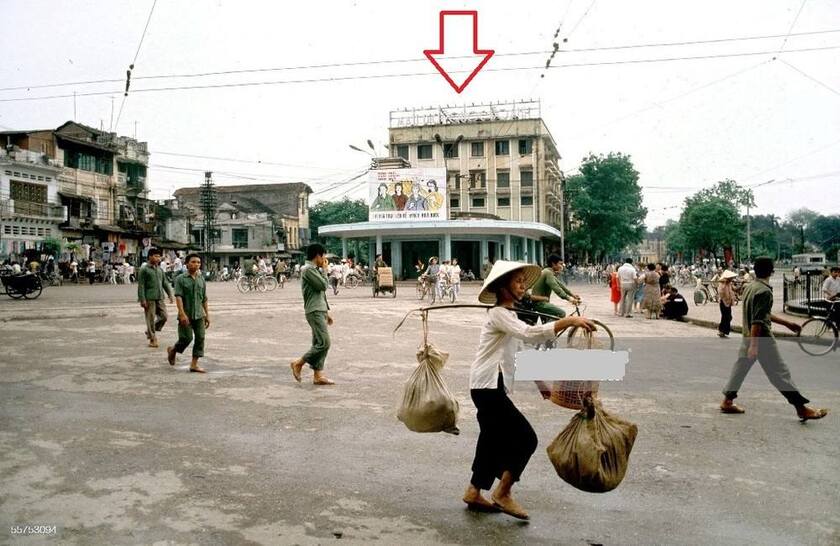
This project has been a part of Hanoi's history for many years.
The first architect to design it was the late architect Ta Xuan Van (1942 - 2020). He once shared with the press: "When participating in the design competition, this building was called the International Trade Center. I strolled through the Old Quarter and Hoan Kiem Lake to find ideas. If you walk from Hoan Kiem Lake through Hang Dao, Hang Ngang, Hang Duong, and Hang Giay streets, the Old Quarter ends at the Hang Dau water tower, a cylindrical structure. Therefore, the building, starting in the Old Quarter, should also use curves to 'harmonize' with the water tower at the end. And curves would probably also suit the shape of Hoan Kiem Lake and the shape of the land. So I took my pen and swirled it on the paper like rising smoke. The design was chosen, and the investor allowed construction."
Back then, hundreds of articles were written about this project, and things got even worse when the building was painted pitch black. It was a major public outcry at the time. Perhaps that's why the name "Shark's Jaw" came about.
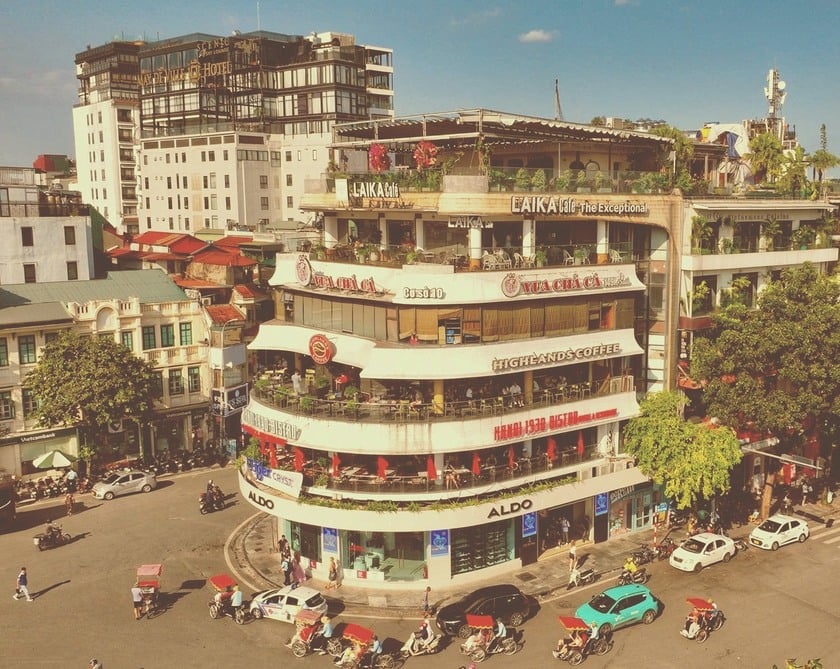
The "Shark's Jaw" building has been a famous landmark in the capital for many years, with numerous well-known brands having business premises there.
After the building received so much criticism, the late architect Ta Xuan Van was invited to revise it. Upon completion, he hoped that the building would become a beautiful memory for Hanoi and that future generations would strive to preserve its most beautiful aspects.
Currently, this 6-story building boasts one of the best locations in Hanoi, with its front facing Dong Kinh - Nghia Thuc Square and its left side facing Hoan Kiem Lake, surrounded by pedestrian streets. The building has 6 floors, with floors 2 to 5 housing restaurants and cafes. The 6th floor offers a panoramic view of Hoan Kiem Lake. Thanks to its prime location, it is also one of the most expensive business locations in Hanoi. Many famous brands such as Aldo, Hanoi Beer, Highlands Coffee, Vua Cha Ca (King of Fish Cakes), and LAIKA Cafe are currently operating here.
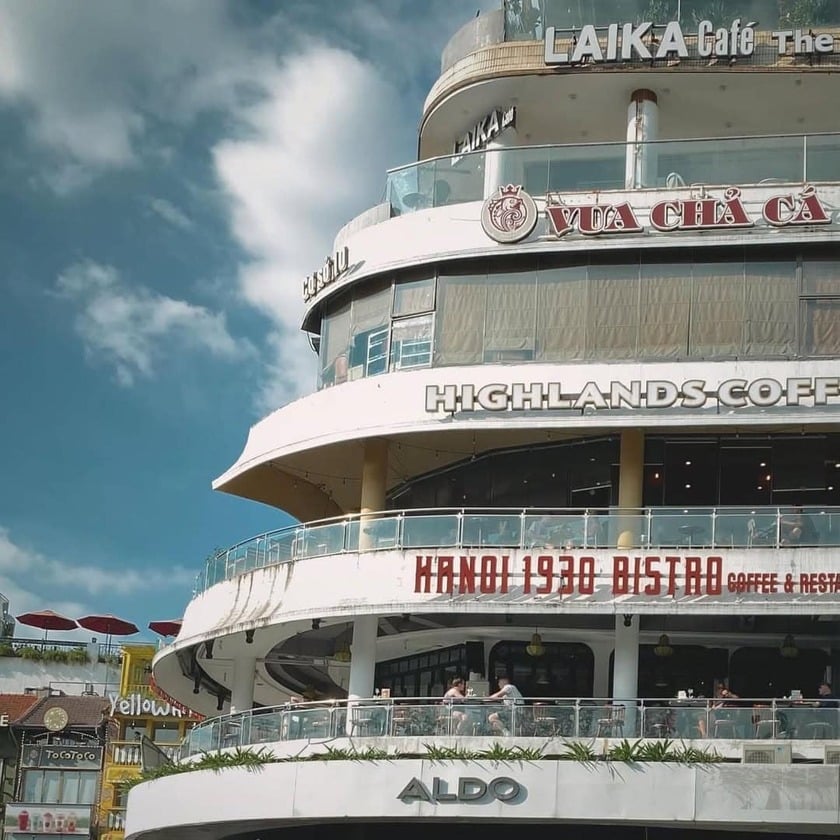
According to many, the decision to demolish the "Shark's Jaw" building and expand the space around Ho Guom Lake is the wish of many generations of Hanoi residents and architects.
Recently, the Hanoi People's Committee Office issued a document announcing the conclusions of Vice Chairman of the Hanoi People's Committee Duong Duc Tuan at a meeting to review the design and renovation plan for Dong Kinh - Nghia Thuc Square in Hoan Kiem District.
The Hanoi People's Committee approved the proposal to demolish the Shark Fin building, suggesting an underground space in the existing square area and an expanded space after the building's demolition; and to study the possibility of approximately 3 basement levels (potentially allocating cultural and commercial space on basement level 1, and parking areas on basement levels 2 and 3).
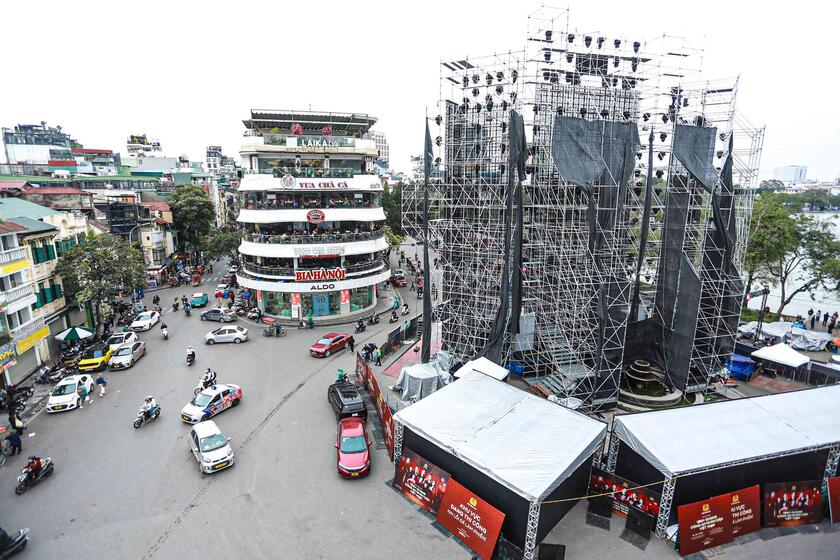
The city has approved the demolition of the "Shark's Jaw" building to reorganize the architectural and landscape space.
According to the Hanoi People's Committee, Dong Kinh - Nghia Thuc Square is an area of high historical and cultural value, connecting two important areas: the Hoan Kiem Lake special national historical site (to the north) and the Old Quarter national historical site (to the south). The renovation of this square is being carried out simultaneously with the research and investment in the construction of other public spaces around Hoan Kiem Lake, as directed by the Central Government, the City Party Committee, and the Hanoi People's Committee.
In the heart of Hanoi, a city steeped in a thousand years of history and culture, urban reconstruction is underway with great fanfare and vibrancy. New buildings are springing up, roads are being widened, and public spaces are being renovated, all contributing to the creation of a modern and civilized Hanoi.
However, throughout this development, Hanoi has preserved and promoted its traditional values and distinctive cultural features. Historical relics, ancient architectural works, and long-standing customs and traditions have all been preserved and promoted, creating a harmony between the past and the present.
Hanoians, with their distinctive cultural identity, are always proud of the history and traditions of the capital city. Past events and present changes all contribute to a common goal: building a Hanoi that is elegant, refined, civilized, and modern. Throughout this journey, the generous and open-minded character of the people of Hanoi has always been clearly demonstrated, from the past to the present. Hanoians are always ready to embrace new things, but they also do not forget traditional values. They always know how to harmonize the past and the present, tradition and modernity, to build a Hanoi that is increasingly developed and civilized.