VI
VI



In the fifth lunar month, after the rice harvest, the fields are scorched by the intense summer sun. Unable to bear the heat, the crabs emerge from their burrows to seek shade under the rice stalks. At that time, we children, those who could brave the burning sun, could simply grab a basket and wade into the fields to collect crabs as easily as picking eggs from a nest.
On ordinary days, when catching crabs, you look for soft soil along the banks of rice paddies where mounds rise up into small, shallow depressions filled with water, then you stick your hand in and pull them out. Sometimes you're lucky and you might find... a snake. But water snakes aren't venomous, and if you catch one, it's a much fresher meal than a bunch of crabs or a basket of fish.
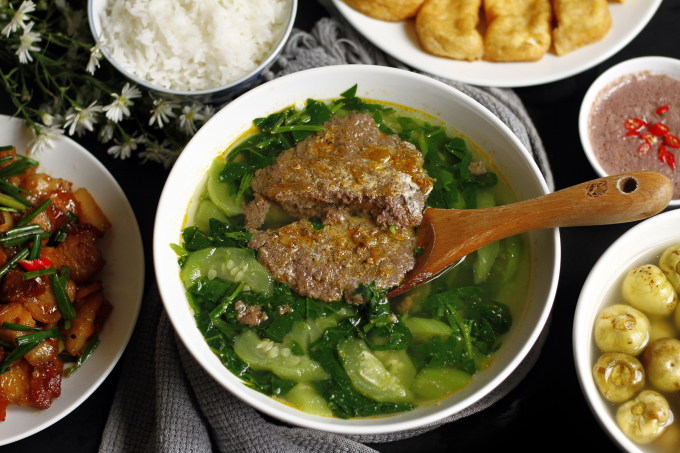
Crab soup with a rich, rustic flavor. (Image source: internet)
There are many types of crab: young crabs that haven't fully grown yet—if we could find these, my mother would gather them, wash them thoroughly, mix them with fermented rice paste, drizzle with fish sauce and salt, and then make a dish of stir-fried crab with fermented rice paste—it was incredibly delicious. If we found molting freshwater crabs, we'd stir-fry them whole. Usually, freshwater crabs were prepared by separating the shell from the body, removing the apron (if it was a male crab) or the underside (if it was a female crab). The apron of a male crab is just a small piece covering the middle third of the crab's body, while the underside of a female crab covers the entire lower part of the body. Female crabs are usually bigger and fatter than male crabs. If a female crab had eggs, we'd gather them in a small bowl and have one of the kids use a toothpick or grapefruit thorn to extract the crab roe from inside the separated shell.
When preparing crabs, my sister would separate the shells while I extracted the roe. Sometimes we'd come across crabs that smelled bad – they had parasites inside their shells. Large, long-lived crabs often smelled bad. If we noticed a bad smell, we'd have to discard that crab and check the rest to see if any were affected. Looking back, I realize that those smelly crabs were actually tastier and cleaner. Much tastier and cleaner than crabs raised using unsafe methods nowadays.

Freshwater crabs are strong, so pinching them is very painful, especially the large ones with moss-covered shells (the kind that live a long time and become old crabs), with big, dark claws like nearly ripe plums. If you don't know how to handle them—using your thumb and index finger to pinch the sides of the crab's shell and lift it up—they'll pinch you so hard you can't get free, you'll be in pain, gasping for air, and screaming. As for those who specialize in catching freshwater crabs, needless to say, their hands will be wrinkled, pale, wet, and covered in crab pinch marks.
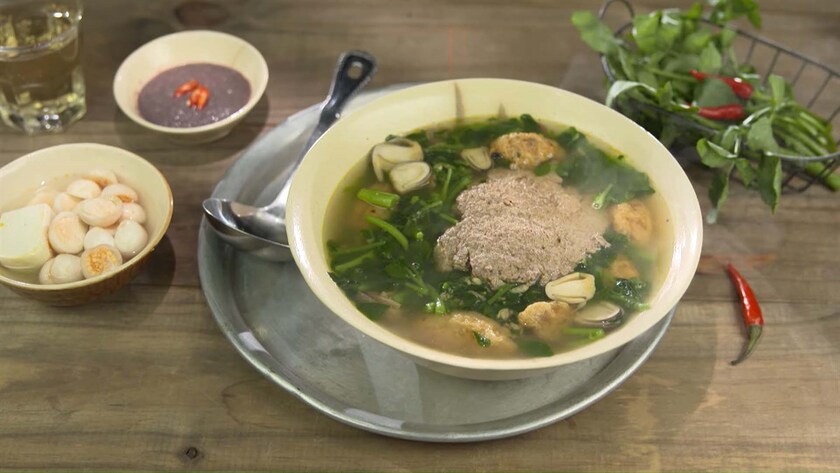
Crab soup and pickled eggplant are two indispensable dishes for summer days. (Image source: internet)
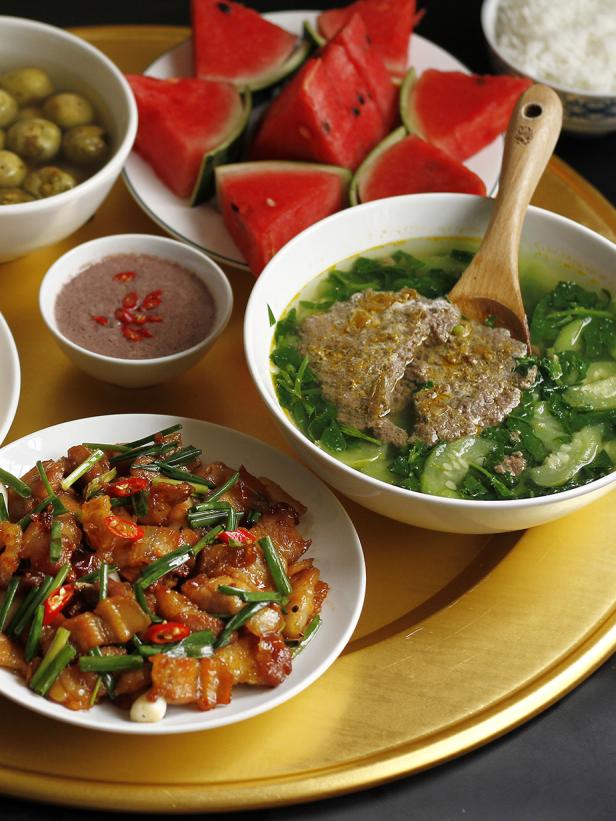
Besides the stir-fried young crab mentioned above, freshwater crabs are often prepared as crab soup, cooked with various kinds of jute leaves, spinach, or mixed greens harvested from the home garden, or even from the fields, pond banks, or dikes. The crabs are separated from their shells and pounded in a mortar until finely minced. Then, a small sieve (made of closely spaced bamboo strips) is used to sieve a pot filled with clean water. After pounding, the crab meat is transferred from the mortar to the sieve and "set to rest" (stirring to allow the crab meat and liquid to flow into the pot, while discarding the shells, claws, or other hard, inedible parts).
After the water has settled, pour it from the still pot into the soup pot. The bottom of the still pot is checked again to ensure all sediment, shells, and other debris have been removed. Then add fish sauce and salt and bring to a boil. Once boiling, add the washed and finely chopped vegetables. Thin, omelet-like chunks of crab roe rise to the surface, emitting a fragrant and familiar aroma. Only when the soup boils again should you add the crab roe and young crab eggs.
Freshwater crabs are small but fragrant, juicy, and tastier than brackish water crabs (rock crabs, which are tough and rather thin) or mud crabs (which are dry and not very fragrant). I remember when we went to Be Ly Son Island, for lunch, my friends and I ordered whole steamed rock crabs. One of my friends, who had braces, found them so delicious that she bit into one and broke a bracket in her braces. We had to "maintain the situation" and only managed to get it reattached back in Hanoi.
In the old days, a simple country meal consisted of just a pot of crab soup and a bowl of quick-pickled or compressed eggplant. Compressed eggplant was a large, round variety, pickled for a long time, pressed down by round, heavy stones taken from the stream banks – these were called "eggplant salting stones." The eggplant was pickled in a dark earthenware jar, tightly compressed and preserved for a long time, absorbing a lot of salt. Each time you ate it, you'd take out a piece, slice it thinly, squeeze in some lemon juice, and sprinkle some fresh chili from the garden – just thinking about it makes your mouth water.
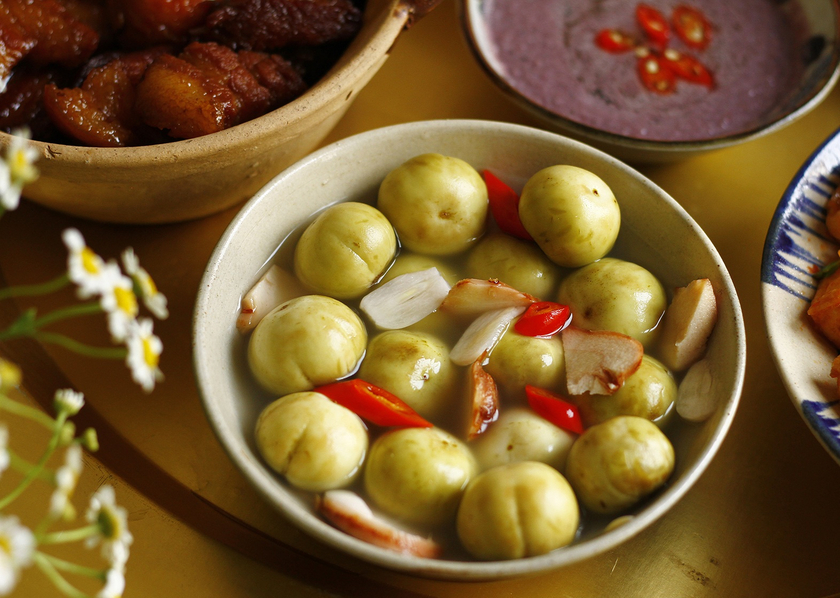
A bowl of crispy, delicious pickled eggplant. (Image from a collection)
In the old days, in every house in the countryside, you'd see a large earthenware jar for pickling eggplant placed next to the kitchen. The water was pitch black, but using that water to cook freshwater fish was incredibly delicious, and the rim of the jar was covered with whitish, anaerobic streaks. For quick-pickled eggplant, they used the small, round variety, which pickles quickly and is eaten quickly. If left for too long, it won't be as flavorful or salty as the larger, more compacted eggplant, and will turn sour. When making pickled eggplant, no matter the variety, my mother always reminded me to cut the stem (the "ear" of the eggplant) so that it wouldn't penetrate the flesh of the eggplant, preventing it from absorbing too much brine and spoiling prematurely.
The dish of rice with crab and eggplant originated here; adding a bowl of fermented crab sauce or fermented anchovy sauce with chopped chili peppers makes it a masterpiece. It's true that in the old days, food was very simple but nutritious, and our ancestors combined ingredients very scientifically, resulting in delicious meals.