VI
VI



Concluding our business trip in Saigon, we took an early bus from the Western Bus Station and arrived in Sa Dec just as the sun was rising but not yet too strong. After a restless sleep, we enjoyed a bowl of the famous Phnom Penh noodle soup and sipped a rich, strong coffee with a thick layer of ice, a characteristic feature of the Southwestern region. All our senses seemed to awaken again, and we set off to get acquainted with and befriend the largest wetland area in Vietnam.
For us, travel encompasses people, scenery, culture, and food. Therefore, the group began with the Ong Pagoda and Ba Pagoda in Sa Dec City – the capital of Dong Thap province.
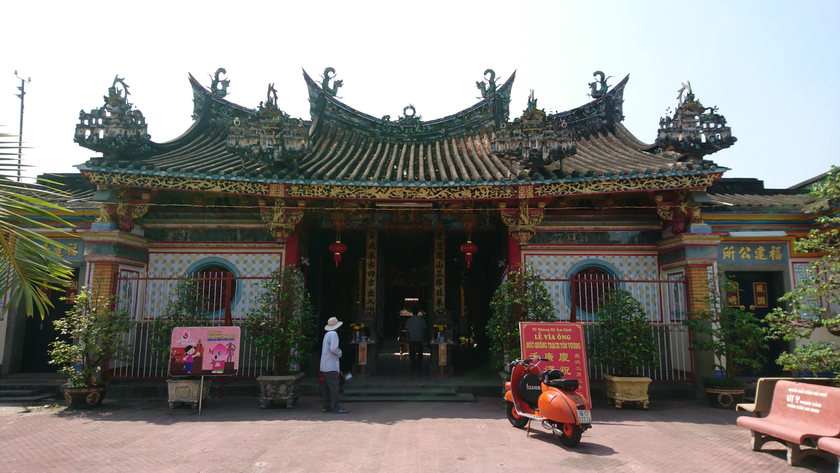
Kien An Palace, also known as Ong Thap Pagoda, is a unique architectural structure.
Architecture in Dong Thap
Kien An Palace (Ong Quach Temple) is over a hundred years old, boasting a unique and magnificent architectural style deeply rooted in Chinese culture.
Ba Pagoda: The pagoda's full name is That Phu Thien Hau Cung, also known as Thien Hau Mieu. It boasts beautiful, colorful architecture deeply rooted in traditional Chinese culture, rightfully earning its place as a unique pair of "male and female pagodas" located in the heart of Sa Dec.
The most unique feature of Ba Pagoda is the large, conical incense sticks with a written prayer placed in the center. When lit, the prayers of the worshipper are believed to be carried by the incense smoke to Nirvana.
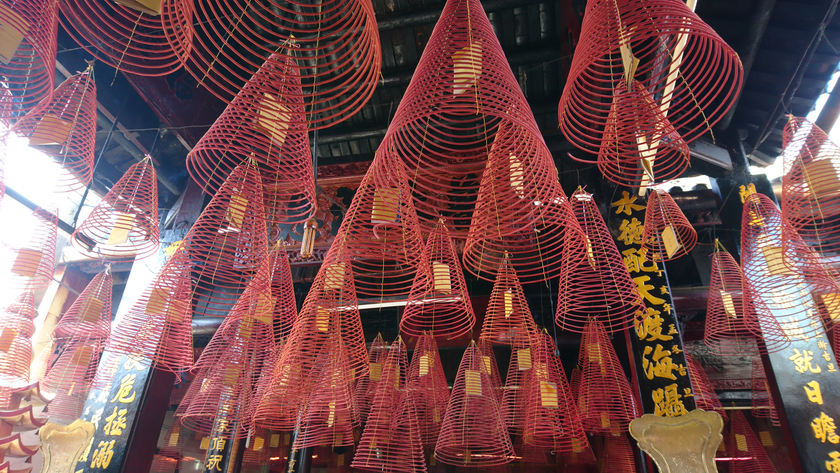
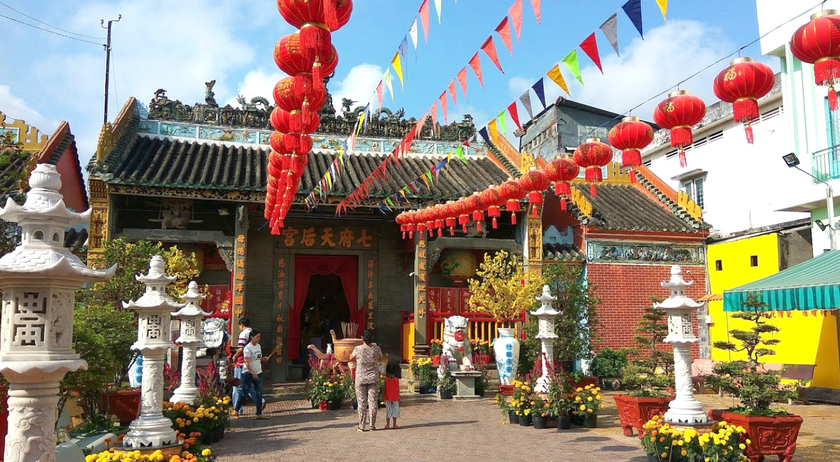
The scenery at Ba Pagoda.
The Huynh Thuy Le ancient house is located right in the heart of Sa Dec city on the banks of the picturesque Tien River. This house, classified as a National Monument, is famous for the love story recorded by the French writer Margueritte Duras in her novel "The Lover" (L'Amant), which was later adapted into a film by director Jean-Jacques Annaud. The cross-border love affair between France and China, with Huynh Thuy Le as the main character, makes Sa Dec (Dong Thap province) the only place in Vietnam to have the setting and origin of this renowned foreign novel and film.
The owner of the old house was a Chinese landowner, so in the center of the house is a statue of Guan Yu, and the doors are exquisitely inlaid with mother-of-pearl, reflecting the luxurious and elaborate Chinese architectural style.
Around midday, the sun in the Mekong Delta was shining brightly but not harshly. We hailed a motorbike taxi and enjoyed the refreshing, invigorating breezes of the delta. Along the way, we suddenly spotted some ancient brick kilns along the Sa Giang River (on National Highway 80), beautifully and elaborately constructed. We stopped to admire the strange and unique scenery, which left everyone in the group in awe.

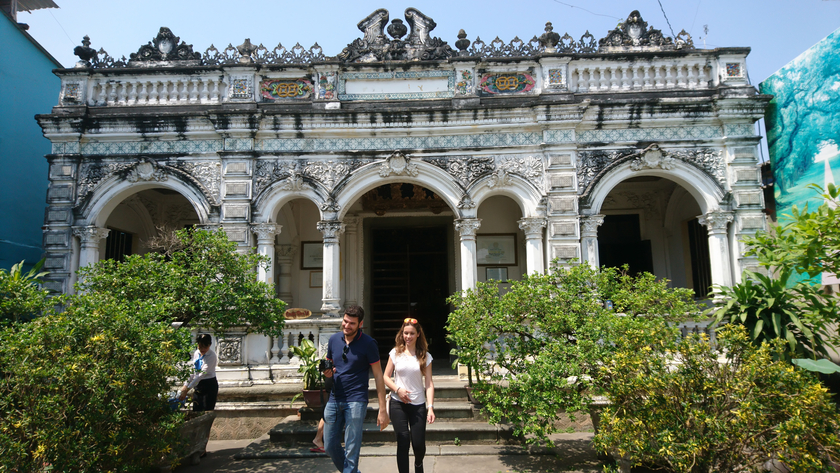
The Huynh Thuy Le ancient house is located right in the heart of Sa Dec city.
The lotus flowers of Dong Thap are already famous throughout the country, with their white and pink blossoms blooming very early. When we arrived in Dong Thap, it was only the beginning of April, but the vast lotus ponds were already in full bloom. Besides their beautiful flowers and fragrant scent, Dong Thap lotuses also yield many valuable products such as lotus heart (a tonic medicine), fresh/dried lotus seeds, lotus silk, lotus milk, lotus roots, etc.
However, the most unique and distinctive is undoubtedly the Lotus Leaf Pagoda (Phuoc Kieng Pagoda, located in Hoa Tan commune, Chau Thanh district) with its ancient architecture, beautiful scenery, and a giant lotus tree in its backyard.
We were amazed to see lotus leaves with diameters ranging from 1.5m to 2m. These giant lotus leaves are said to originate from the Amazon rainforest (Brazil), with some leaves so large and sturdy they can support a person or object weighing up to 70kg. With a protective cover to prevent the leaves from breaking, you can stand on the lotus leaf to take photos and experience this unique and exciting sensation.
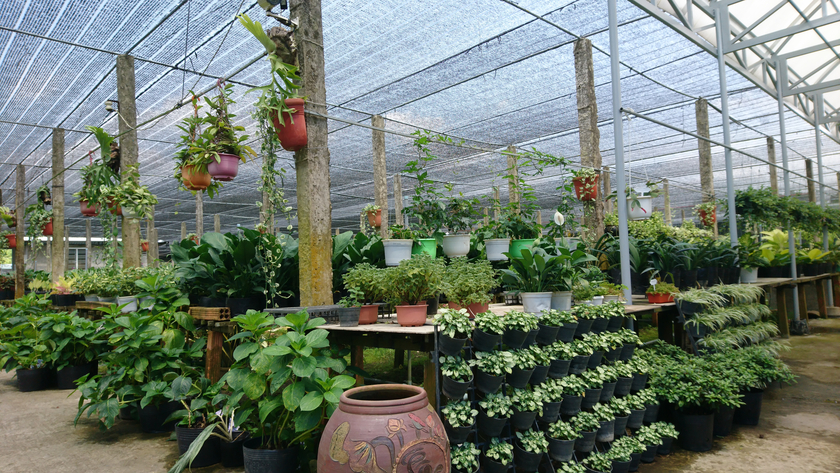
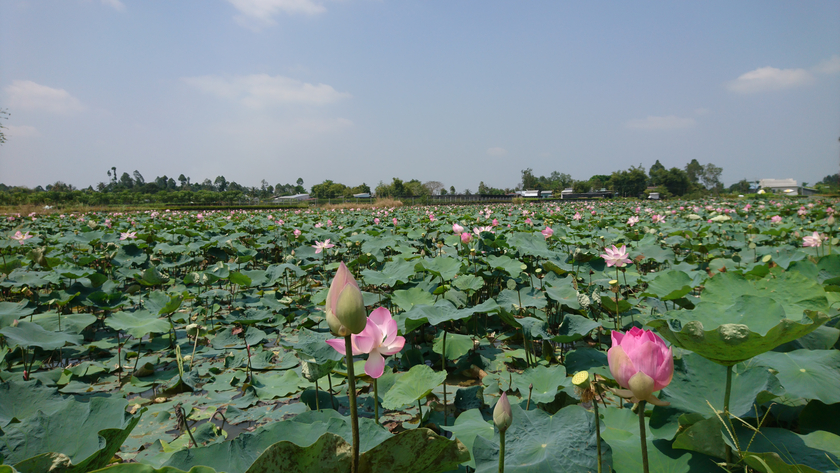
When visiting Dong Thap, you must see the beautiful flower gardens.
Sa Dec Flower Village originated as Tan Quy Dong Flower Village, a traditional craft village over 100 years old located on the banks of the Tien River, blessed with year-round breezes, fertile alluvial soil, and abundant sunshine. Known as the flower capital of the Mekong Delta, a visit during the Lunar New Year season would offer a spectacular sight of countless flowers in bloom, exuding fragrant aromas, much like what we've seen on TV and in calendars. While early summer isn't the peak season, visiting is still a chance to experience it, but the village is no less magnificent, brimming with life from newly germinated seeds, seedlings, and budding flowers.
Leaving Sa Dec, we took a bus to Cao Lanh ferry terminal, crossing the Tien River from Lap Vo district to Cao Lanh city. The new Cao Lanh bridge had just opened to traffic, and this ferry terminal had ceased operations at 0:00 on August 24, 2020.
Arriving in Cao Lanh as dusk was falling, after checking into the hotel, the group gathered to visit the historical site with the tomb of Deputy Scholar Nguyen Sinh Sac, President Ho Chi Minh's father. The tomb was designed and built solemnly, surrounded by ancient trees, many of which were labeled "heritage trees".
Cuisine in Dong Thap
For dinner, we visited a typical Southwestern Vietnamese restaurant: a wooden entrance crossed a rice field, surrounded by a vast lotus pond emitting a gentle fragrance. The restaurant itself was a series of thatched huts, and as the summer moon rose higher, the space was filled with the splashing of fish and the croaking of frogs in the distance, creating a peaceful, almost ethereal atmosphere that made us feel lighthearted and carefree.
"When you come to Dong Thap, you have to eat rat meat," our friend, a native of the Southwest, initially said, and we thought he was joking. But the restaurant menu did indeed include several dishes made from… rats. The receptionist reassured us, explaining that the rats here are called "melaleuca squirrels," and they only eat rice, melaleuca flowers, and melaleuca tree sprouts, so they are very healthy and nutritious. Furthermore, the restaurant had been inspected and certified by relevant authorities as meeting food safety and hygiene standards.
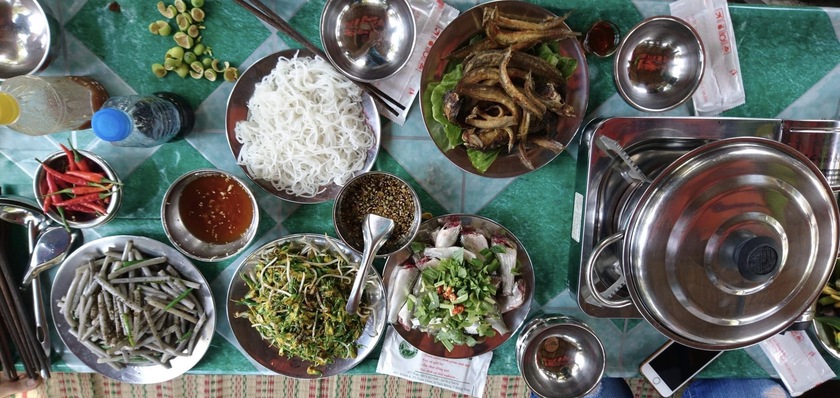
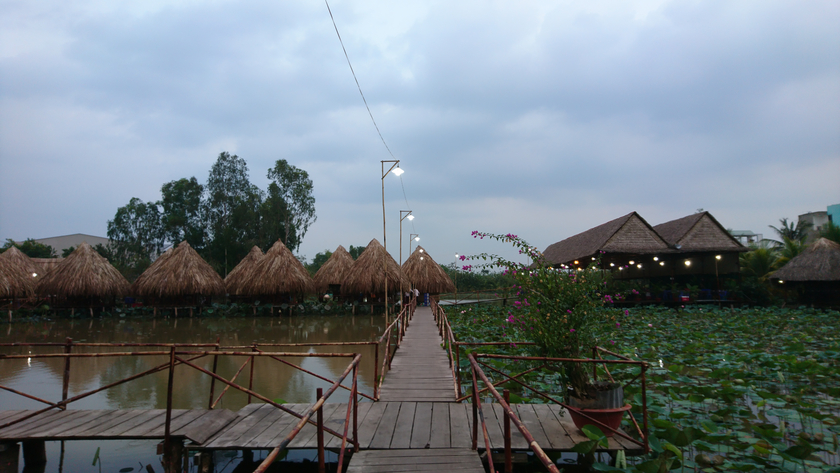
A riverside-style restaurant in Dong Thap.
So, in addition to the typical dishes of the Southwest region, we boldly ordered a plate of grilled rat. Everyone was curious, so when the flight attendant brought it out, everyone eagerly examined it and tasted it together: fragrant, delicious, and the taste was similar to other rodents we had tried before: rabbit, squirrel, bamboo rat… The whole group was excited to try this "slightly gruesome" yet very distinctive specialty dish for the first time.
The next morning, we woke up early, rented motorbikes, and began our journey to the most anticipated destination: Tram Chim National Park in Tam Nong, Dong Thap. The whole group was neatly dressed, ready for a nearly 80 km (round trip) journey under the beautiful sunshine. Along the way, we occasionally came across drying yards of ripe, bright red chili peppers, emitting a rather unique aroma. Especially noteworthy was the blooming season of the Omoi flowers, a characteristic flower of this riverine region, known as the "Southwest Cherry Blossom." The flowers bloomed in clusters, displaying a vibrant pink hue that delighted us all, prompting us to admire them and take countless photos.
We had spent several days exploring the waterways, but when we took a motorboat (tắc ráng) into Tram Chim National Park, we still couldn't help but feel overwhelmed. Overwhelmed by the sheer scale of this Ramsar site, the fourth largest wetland in Vietnam, and overwhelmed by the dense, abundant vegetation of this land that experiences "six months of dry, parched land and six months of flooded fields." The feeling was one of novelty and delight as we meandered along the cool, green canals, observing birds of all sizes, colors, and shapes soaring and searching for food. The motorboats for tourists use a separate lane, usually speeding along, so birds rarely flock through that path. If a few do appear, they are very wary and alert; as soon as they see tourists raising cameras, they dart away.
During the day, when the birds disperse to find food, even climbing to the observation tower in the middle of Tram Chim National Park only allows you to admire the vast expanse of trees, canals, and the sky of the Dong Thap Muoi region. But as dusk falls, flocks of birds return to their nests, filling the sky with their calls and creating a noisy atmosphere. The waterbirds here comprise 233 species, belonging to 25 genera and 49 families, of which 88% are found during the dry season, accounting for a quarter of all bird species discovered in Vietnam in the area located within the boundaries of 7 communes: Tan Cong Sinh, Phu Duc, Phu Tho, Phu Thanh A, Phu Thanh B, Phu Hiep, and Tram Chim town.
The trip ended with a bouncy feast on a motorboat in Tram Chim National Park, featuring grilled mudfish, boiled snails with chili fish sauce, snakehead fish hotpot, stir-fried water hyacinth flowers with peeled shrimp... There were also fresh lotus seeds, sweet and refreshing with a slightly bitter taste. The strong, spicy rice wine of the Mekong Delta was smooth on the lips, the sky was breezy, the water rippled, white and pink lotuses, purple water lilies, and green grass swayed gently, occasionally a bird would stick its long neck out from the bushes to look around before flying away.
Reluctantly leaving, I promised to return to Dong Thap someday to discover more fascinating, unique, and one-of-a-kind things found only here.